
Commodifying Aso Ebi: Weaving Unity or Threading Divides?


In Lagbaja's 2005 song "Skentele Skontolo,” he emphasised the iconic fashion of the Yoruba people, proclaiming, "ko si fashion kan to ju ti a lo iro ati buba yen pelu gele skontolo," meaning there is no fashion that surpasses ours, with iro ati buba (wrapper and blouse) and the elaborate gele.
Indeed, Nigerian fashion has been influential across Africa and the diaspora, extending its impact across international borders. Traditionally, in Yoruba fashion women will wear iro ati buba and men an agbada and fila; historically the materials used for these outfits would be aṣọ òkè, adire, swiss lace and others. In more recent times many different styles have been introduced reflecting more modern and globalised approaches to fashion.
In contemporary discourse, the term "aso ebi" has woven itself into the fabric of social discourse, regularly cropping up in discussions surrounding social gatherings, whether for weddings, birthdays, or funerals. Long associated with Yoruba and Nigerian owambes (or owanbes), the phenomenon has transcended its cultural origins beyond Yoruba communities, now embraced by various ethnic groups.
Beyond Nigeria, aso ebi serves as a cultural identifier connecting communities with Yoruba cultural practices. Yet, amongst the colourful and extravagant styles that define it, conversations have emerged regarding its historical roots, contemporary significance, and the challenges its evolution now poses within culture.
Origins of aso ebi
Aso ebi, when translated means "family cloth" and stands as a uniform fabric used during special celebrations or ceremonies, serving as a gesture of unity and support among family members and friends.
Originating from the cultural roots of the Yoruba people in Southwestern Nigeria, aso ebi has evolved from an exclusive family tradition to a broader expression of communal solidarity during events such as weddings, birthdays, burials, and landmark anniversaries.
While its historical roots were embedded in familial ties, the dawn of the 20th century witnessed a shift, with the terminology aso ebi supplanting the concept of "egbejoda" (group uniform) and thereby departing from the requirement of blood relations for participation. By the early 20th century, traditional styles were highly sought after as the preferred attire for special events, especially among urban classes and elites, as there was a tendency to favour domestically produced textiles over foreign imports. Additionally, aso ebi (or rather egbejoda) played a significant role in the political landscape, with traditional attire serving as a symbol of resistance against European influences, aligning with pro-nationalist sentiments.
Aso ebi has now become an inclusive symbol no longer confined to family circles. Both family members and friends now partake in celebrations by wearing aso ebi fabrics tailored to their chosen designs. In the past, aso ebi was characterised by strict uniformity, not only in fabric selection, but also in style. Though over time, this thread of rigidity has considerably loosened, giving rise to a surge in individualistic style choices and self-expression. Erin M. Rice, in her dissertation titled "The Pattern of Modernity: Textiles in Art, Fashion, and Cultural Memory in Nigeria since 1960," observes,
"in a sense, the factory print allowed aso ebi participants to stretch the limits of uniqueness within conformity. In doing so, Lagos’ citizens reinvented the notion of a national or culture-specific fashion."
How it works
When planning an event, the host selects a preferred aso ebi fabric, increases its price, and sells it to family and friends, often as a means of generating profit. Guests within this social circle are expected to purchase the fabric as a gesture of support, regardless of whether they intend to attend the event, but this obligation has proven burdensome and contentious for some individuals.
The cost of celebration
Financial burdens have long accompanied aso ebi. In the early 20th century, newspapers in Nigeria were receiving letters complaining about the financial demands of aso ebi. Particularly among Yoruba grooms, as it was customary for the groom to bear the cost of the aso ebi for the bride's family, a practice known as "owo aso iyawo." Fast forward to more recent times, the financial strain associated with aso ebi has continued to create discontent.
An academic paper titled "The Ethics of Aso Ebi Culture in Nigeria," published in the Journal of Culture, Society, and Development, reported that the aso ebi fabric often carries a markup ranging from 20% to 50%, a non-negotiable increase. This substantially increases the expenses for attendees, who not only purchase the fabric but will also incur additional costs for tailoring. The study also revealed that the pressures to participate in aso ebi have led some individuals to resort to borrowing money to fulfil these obligations. Critics argue that event organisers enforce aso ebi purchases not only to recoup event expenses but also to potentially turn a profit, diverging from the tradition's original cultural intent. This raises questions about whether such practices should continue to be endorsed, as they can amount to forms of extortion.
The social implications are equally fraught. The commodification of aso ebi has, to some extent, reduced it to a profit-making venture. Participation can confer social advantages, while opting out risks exclusion or social censure. Instances of social exclusion or being labelled as unsupportive are not uncommon if one chooses to opt out. In some extreme cases, attendees may even be cautioned to not attend.
Additionally, those who wear aso ebi at events, are often said to receive preferential treatment, this may manifest in being the recipient of privileged gifts and greater hospitality. These dynamics create an environment of transactional social performance and obligation, imposing both financial and social pressures on individuals, particularly on those lacking the means to participate.
Sustainability, consumerism, and the decline of the domestic market
The rise of aso ebi also raises concerns around sustainability and its impact on domestic markets. The widespread adoption of the trend, has led to an unfavourable shift towards mass produced factory and imported fabrics, primarily sourced from China.
This transition is driven by a growing preference for cost effective and readily available materials, which, in turn, has had a significant impact on Nigeria's domestic fabric industry and indigenous textiles like locally crafted aso oke. The increased demand for affordable materials has contributed to the closure of nearly all textile factories in Nigeria.
In the past, to bolster the Nigerian textile sector, the federal military government rolled out initiatives aimed at safeguarding the industry. Measures such as the 1972 Indigenisation Decree were put in place, barring foreigners from textile enterprises (and other industries) to provide Nigerians with a larger share in the national economy and stimulate the development of local industries. However, this policy was ineffective as it failed to address the industry's core issues - such as lack of modernisation, good infrastructure and capital.
In the 90s and 2000s, the industry witnessed a decline, and businesses struggled to maintain profitability. In 2002 the Nigerian government rolled out their initial restriction on textiles. However, various structural issues, including challenges with oil, inadequate infrastructure, corruption, and the influx of Chinese products through smuggling, contributed to the downturn. Rice explains that
“The prices of Chinese imports were set so low that the competition was nearly eliminated, and any attempt at regulating the trade was undermined by rampant smuggling, counterfeiting, and government corruption.By 2007, the Guardian reported that 80% of Nigeria’s textile market was dominated by Asian imports. A combination of these factors led to the closure of approximately 170 of Nigeria’s textile manufacturers by 2008.”
In a bid to resuscitate the industry, Nigeria implemented a ban on textile and fabric imports in 2008. In 2015, the ban was lifted, accompanied by a 35% import duty tax. As of 2022, foreign imports now constitute between 80% and 90% of the market.
The matter of sustainability only complicates the aso ebi phenomenon. Often, aso ebi garments are worn just once, left to collect dust in closets once an event is over. This essentially categorises aso ebi as a form of disposable fashion. The practice not only contributes to clothing waste but also poses questions about the ethical implications of a trend that encourages single use garments. This prompts the need for a broader discussion of its environmental impact and the need for responsible consumption within the context of aso ebi.
Final Thoughts
The endurance and significance of any tradition is hinged on its ability to enhance community life. The fluidity of cultural practices shows a constant evolution, with some gaining prominence, while others fade as their relevance diminishes.
Aso ebi remains, at its best, an endearing expression of unity, style, and cultural pride. It continues to epitomise culture, whether observed at home or in the diaspora. Although, its commercialisation, financial demands, and environmental impact do necessitate more thought. With its ongoing cultural evolution, it is crucial to remain mindful of its trajectory and evaluate whether certain manifestations are more detrimental than beneficial.
So, the question now is whether this cultural emblem will evolve responsibly, preserving its values while accommodating modern realities, or whether its glamour will be overshadowed by the pressures of profit and performance.
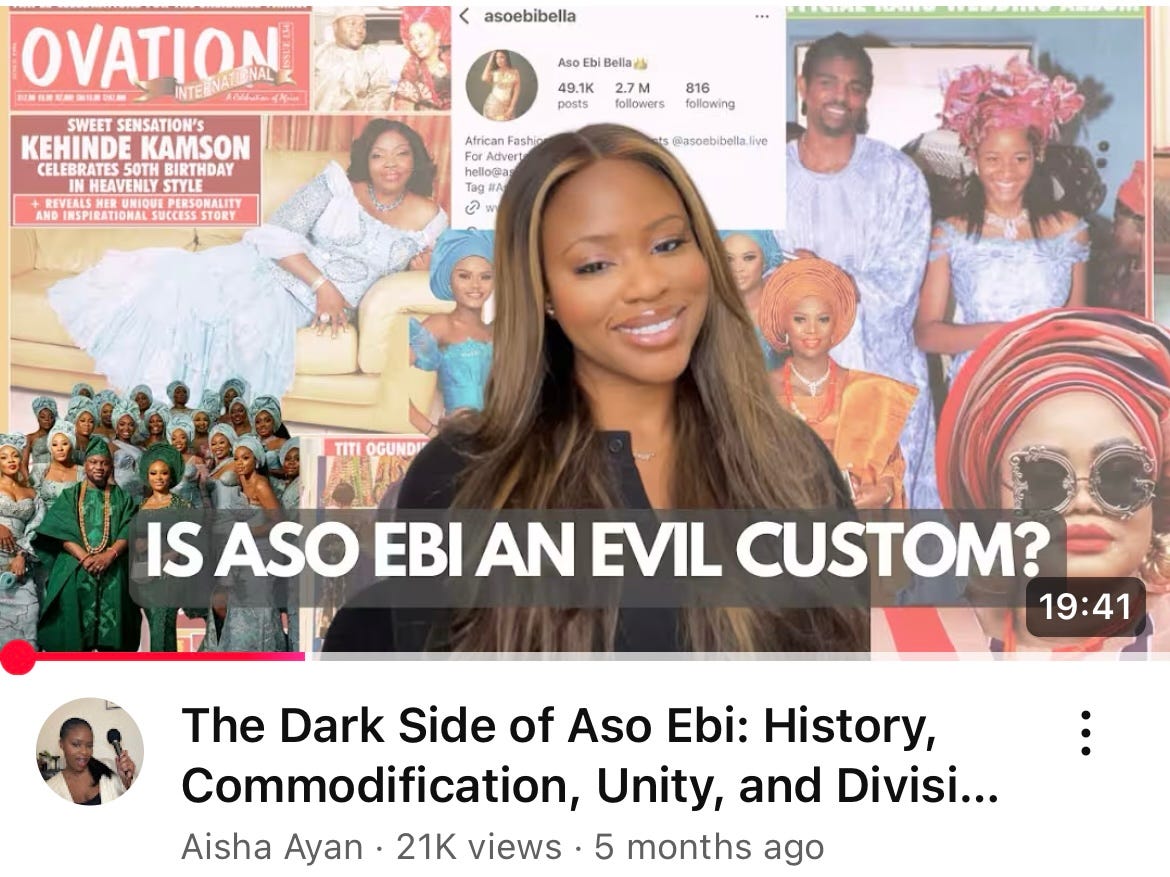
This article is accompanied by a video essay that dives deeper into the topic: Watch here
Food for thought